My Tags

Friday, October 20, 2006

The Limits of Co-Creation

I'm all for the whole reversioning content and taking ownership vibe.

But then I saw this here.


Wednesday, October 18, 2006

V-Dubs Rock!


Another great idea from Crispin Porter Bogusky. The premise: buy a Volkswagen and we'll give you a guitar (which, just by the way) you can plug into the cars' stereos.

I love the sheer off-the-wallness of the idea. Its entertaining to watch. And it's not just for guitar freaks, it gives the brand some interesting associations of rock, rebellion, jamming and humour.

Oh and check out the ads on Youtube.

Top banana.

Tuesday, October 17, 2006

Gossip in the town square

It was only a matter of time before we saw the emergence of marketing companies trying to facilitate brands' conversations with people online.

This US business tells a good story, and it feels that new technology has allowed them to widen their offer. But its still all about listening to the latest farming tips in the market square, acting upon it and later gaining customer feedback on your efforts.

Same old same old huh?

Wednesday, October 11, 2006

Gigantic Optimistic Bravery

I attended a great conference today. The APG's Battle of Big Thinking. Good format in that every speaker was given only 15 minutes, which meant the good ones threw out lots of great ideas and the boring ones didn't go on too long.


I took a lot away about the brand-marketing-communications-creative-media-advertising'sdead industrial complex. But mainly I took away some inspiration and some refreshing perspectives. I guess I might revisit some of them in the coming weeks, but for what it's worth, here are a few I thought would be of interest;

1) The marketing industry can be a bit of a dinosaur. And the point is that the old way of engaging with customers at a mass level is under serious threat. So what should you do? There's no put in trying to evolve the best dinosaur you can if a new ice age is just around the corner. Far better to be little agile warm-blooded mammal.

I guess mammal-like things at the moment for me are harnessing the power of the web in a bid for brands to facilitate conversations, and recognising that by giving up control, brands can actually gain influence. (I'm pretty sure there's a judo reference in there somewhere).

2) I loved the idea of future planners as Ronin, hired hands adapting themselves to whatever mission they're undertaking. The idea that planners, like great online businesses, should always put their work out there in a Beta version was cool. The point is you've got to have a go. If you wait for the grand unified theory of marketing, youy'll never get anything done. This I think ties in nicely to the web aesthetic of hand-made, that I'm really interested in at the moment.

3) Actually it's not about 'big ideas', which are impossible to ground in reality, too precious to be messed about with and generally a block to doing good stuff. No, its actually about the little ideas, the little things we can do to make a difference. As Trevor Beattie put it, 'Every Little Helps but Every Big Hinders'.

PS. Russell Davies was really inspiring, Jim Carrol (BBH) was very plannerly and Ivan Pollard was very slick.

Monday, October 09, 2006

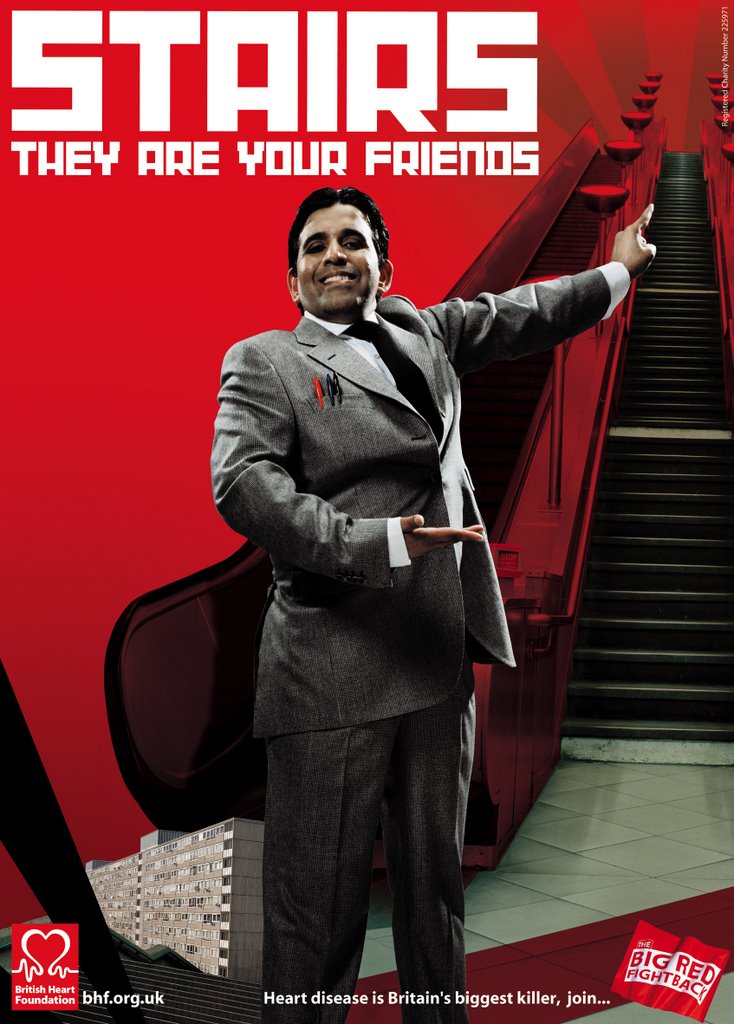
Stairs, they are your friends.


I've been pondering the interplay between the medium and the message for a while now.

It is clear that using media or connection opportunities can help shape the message and bring it to life. Showing that you've thought about the interaction between the message and where you see it, broadens the creative idea. It takes it into another dimension.

Think of the British Heart Foundation, exhorting you to take the steps (rather than riding the escalator) in tube stations, for the sake of your heart.

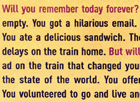
Or think about VSO (Voluntary Service Overseas) who placed ads about life changing meaningful experiences on the London tube, where the depth of commuter despond is thoroughly plumbed.

I suppose the trick to coming up with opportunities like these it to start at the strategic end. What are we trying to communicate? Who are we reaching? Is there any way of bringing the thought to life in a physical way for the consumer?

One idea I'm keen to try out is the 'lost' car key.

Here's the deal; for a car client looking to get more test drives, why not drop a series of real looking car keys and fobs in pubs, or restaurants, the backs of cabs or even the supermarket. In short, wherever your target market goes. You spot car keys on the floor, of course you're going to pick them up. And that's when I've got you - with a carefully crafted and charming message on the back that exhorts you to take a test drive or win a car etc. Its interruptive I know, but I'm sure the copy can offset that. Plus its a new way to reach a market that might not view more traditional media. An even better idea would be to embed an RFID tag in the key fob offering you for example free public transport to the nearest dealership. C'mon... any takers?

I was motivated to write a little about this, having seen Cubemate's post here. Cubemate, aka Dan Ng, is one of the brightest stars in the Planning firmament and I urge you to subscribe to his blog.

Friday, October 06, 2006

Immerse yourself

We wanted to share the excitement and transfer some of the closeness that you get to powerful beasts of the sea at Sea World Florida. Both are concepts only, using outdoor to raise awareness.

Tuesday, October 03, 2006

Why Paris Hilton is Madonna 2.0

Read a great article today that argued that Paris Hilton isn't so much a modern celebrity as a marketing platform like youtube.

The point is that although every song or book she produces totally dies, her omnipresence in popular culture provides her with an inestimable market value. She constantly links to other brands (desingers, restaurants, night clubs, other celebrities) and they constantly link to her.

Guess its true of Posh and Becks too in a way. Though it saddens me to see their level of linkage dropping off, as their popularity wanes.


Monday, October 02, 2006

Tell me that you love me, that its not a one-night stand.

Its less glamorous than selling cars.
And it's hard to do customer service really well.
But After Sales is critical to the customer's experience of the product and therefore the brand.
This campaign encourages drivers of older Volkswagen cars to re-consider getting their servicing and maintenance done at the local Volkswagen dealership.


Friday, August 04, 2006

Wednesday, August 02, 2006

Malcolm Gladwell talks Chairs

Listen here to his lovely talk about the risks in taking what people say at face value. Another nail in the coffin of bad consumer research...
1) Preferences are unstable - think the Coke sip.
2) Beware the perils of introspection: making people explain what they want actually changes their preferences, and often kills innovation.
3) When people explain their actions, they often just make it up, because accessing the unconscious is very difficult.

Tuesday, August 01, 2006

More on Mass Creation

There's just something so compelling and fascinating about the idea of Mass Creation: The creation of content by the masses. Perhaps its because at heart its all about shifting the balance of power. From heavily controlled, high barriers to entry for the production and communication of the written word, pictures, audio and video to the absolute opposite. As long as you've got a computer.

But there's an interesting paradox at the heart of the freeing up of content creation, namely the desire of big media companies to get in on the act and make money out of it. Think of News Corp buying MySpace or Walmart's very own heavily-controlled 'Hub'.

For brands wanting in on the act, its critical to refrain from polluting public spaces. You wouldn't expect people to want to read papers totally subsumed by advertising - you've got to leave room for entertaining content. But its too easy to assume that brand associations with mass created content have to be negative.

If brands help create and sustain meaning and identity, if they FIT with the audiences' aspirations and fantasies, then they're playing a significant role in peoples' lives. And it won't feel like they're treading on toes.

Friday, July 28, 2006

Digital is a state of mind.

Digital is a state of mind. It is not a channel.

This is a perspective that radically alters the balance of power between producer and consumer.

Now the consumers are producers. We are in the era of Mass-Creation. In one day, YouTube uploads a Blockbuster outlet’s worth of video content.

Digital technology hasn’t so much created a fragmented multi-channel world as a one-channel world, yours. Think Google and Yahoo’s customised home pages gathering all your favourite feeds into one place.

Now the consumer has become a media owner too.

The barriers to broadcast (or more often narrowcast) have disappeared as teenage girls post their thoughts immediately into blogs whilst IMing their friends.

It used to be all about the big creative idea. And it still is. The difference is that now, the big idea can be reversioned and reproduced in myriad different ways. Instantly.

The age of creative ideas and campaigns owned by brands, their advertising and media agencies is ending. Today Chevrolet gets the public to co-create their campaigns. Sometimes with embarrassing results. Think suicide bomber in a VW polo.

Control has already been relinquished. Anti-McDonald’s websites were just the start.
Control was a myth anyway, convenient for marketing professionals but totally bogus. A brand exists in the minds of the public, it is ultimately devolved.

Yesterday, brand managers hoped that the stimulus they created would help shape perceptions positively, would encourage the right word of mouth. And ultimately sell their products and services. Today their hopes are the same, but the challenge is more complex. And more interesting.

All forms of traditional marketing agencies at heart are afraid and unhappy with the birth of a world where their favourite medium isn’t king by divine right anymore. But this is simply a fear of change.

What frightens them is not knowing how to reach large numbers of people with a well-crafted story anymore, when channels are fragmenting and stories get edited, twisted and reframed.

Perhaps they need to take a lesson from the martial arts? Don’t oppose your opponent’s energy, it’s wasteful. Use it instead to achieve your goal.

The best brand strategies are being designed to embrace the world of Mass-Creation and to harness the power of the one-channel media owner. Tomorrow’s successful brands already revel in the power of peer-2-peer review, seeing the customer as a channel on a scale that dwarfs the audiences of 1960’s TV stations.

When you look at it that way, you realise there are two ways of seeing the change. It’s either the death of the era of mass-marketing, as we descend into a dark age, seething with rubbish content, lies, confusion and chaotic extremism furthering personal prejudice. Or it’s the dawn of a golden-age, as significant as the Renaissance, a great flowering of creativity and the birth of new communities of interest that will change the World for ever.

So what about brands and their creative ideas in this brave new world?

1. Devolve ownership, become a brand Steward not a brand Director
2. Encourage co-creation with the customer in everything you do
3. Harvest the best of your advocates’ creative efforts and distribute it
4. See your consumers as a channel in their own right, remunerate them accordingly
5. Turn your brand from an artificial abstracted construct into a lifestyle channel for your chosen community…
6. … and facilitate the best Wiki in your category
7. Develop a deep and penetrating understanding of your communities of interest, do it by participation, not by remote observation
8. Segment your offer in manifold ways to make the most of the long-tail
9. Break down the walls of the firm and create a porous wall to encourage osmosis with your community
10. Don’t limit access to your business, products or people; make everything available everywhere all the time on every platform
11. Turn your brand story from a monograph into a participatory soap opera
12. Align formal partnerships according to the web of interests that your communities have created
13. Put as much creative effort into your analytics as you do into artwork
14. Make sure the content you create is enlightening and engaging, refresh it regularly

Thursday, May 25, 2006

"I need to believe"


I just love this promo by Chemical Brothers. Seems to capture the terror of the industrial age brilliantly. Perhaps Neil Ludd was right.

Leo's Communications Principles #1


Principle #1: Just because you can, doesn't mean you should.

I'm all for creative usage of media to communicate marketing messages, or a company's ethos or just some positive associations. But I'm not a believer in Creativity that simply used to show quite how clever you are. Or Creativity that exists simply because it was possible to do it. Creativity practised properly in a commercial context has a business end in mind. If not its art. And Art is great, but why ruin it with a nasty aftertaste of Capitalism.

This site, for London ad agency Mother is a great example of up-its-own-arse creativity. Have a look and see how long it takes you to find their work before you give up. Whoever put this together got so close to the design that they forgot about the rest of the world. I suggest they need to look up 'Usability'.

Friday, April 28, 2006

Anti-Virus


This is where it is at: great example of a brand (MacDonald's) being attacked using informative and engaging content. Just like No Logo its my job to learn and adapt. Think Virus/Anti-Virus.
http://www.kontraband.com/show/show.asp?sf=y&id=3454

How to get ads watched.

One of the many interesting things about delivering marketing messages via the web is that viral TV ads really make you pay attention. Plus they engage you in an action, either deleting or forwarding. It's such a brilliant way to get people involved. Try this one, from an American Gym company.

Monday, April 17, 2006

Reasons Why

Malcolm Gladwell recently wrote a review in the New Yorker of a book called 'Why'. All about the kinds of reasons people give for their actions. There's an interesting critique here of focus groups, where people often rely on 'convention' reasons to justify their actions and attitudes. In reality the reasons for our behaviour are far more complex. See Leo Burnett Planner's comment here.

In summary though, reason giving is dependent on our context and the reltationships and roles we are playing at the time we give the reason, not on some kind of totally rational argument - "Effective reason-giving, then, involves matching the kind of reason we give to the particular role that we happen to be playing at the time a reason is necessary".

Monday, March 27, 2006

Great Short Stories, the easy way.

Create the mood, set the scene, then add a crazed twist. It's that simple. By introducing a surprising element, you add tension, mystery and interest. Then the reader/viewer is hooked.
See this winner of a short film category called Duncan Removed. Would love to see the full version, not just the trailer.