My Tags

Sunday, March 18, 2007

Luigi Colani

Saw a really interesting exhibition at the awfully elitist Design Musuem yesterday. Luigi Colani, is an 80 something designer of products, objects, cars, tea-sets etc


.


What struck me most was his unbending faith in using nature as the blueprint for all of his designs. He's been so successful that today, organic forms in product design seem quite the norm.


But this guy's been doing it since at least the 50's. Some of his designs looked totally futuristic, even today.
There was an interesting contrast showing traffic on a modern German street, as a backdrop to one of his car designs... surprise, surprise, modern cars look very conservative and box-like.


An inspiration.


Saturday, February 10, 2007

On Interesting


Its so true. Interestingness is a great way to get brands and people to connect. These series of short films for Nike are worth watching in their own right. They don't make me want to wear Nike Airs though. But perhaps that isn't always the point. They do give me a sense of how rooted in the culture they are. Think hiphop/new york/basketball.

Too often we only look to satisfy peoples' interest in the product or service and what it gives them, but satisfying an interest by sharing in a wider cultural idea is so much fuller, richer and more engaging.

Monday, January 01, 2007

The Tagmeme

Thanks to Matt at Thoughtcrime for tagging me with the most bugging early morning mental workout - but then blame Dan at Cubemate too I guess. The workout? Five things about you that people don't already know.

1. I used to be the lead singer in an Indie band (circa 1990-92). We made one demo *tape* in a studio... which kind of says it all really. Our drummer couldn't keep time. My dulcet tones were however, something else.

2. I've written hundreds of songs. Almost all of them immediately vaporised. I got into music writing, sampling and beat programming during the techno era and spent hours writing wannabe rave-anthems... then I'd get sick of hearing them loop and loop again, so moved on to the next one.

3. I keep meaning to be a writer. Written some poems that I like, not nearly enough articles and started some short stories. Including one that is one sentence long... the famous 'mini saga'. One day I'd like to just write from a countryside haven and make enough to get by.

4. I'm almost French. Well not quite. But I did spend most of my childhood living in Paris so I'm bilingual. Handy when on holiday in France. And when swearing at French colleagues at work.

5. I like lots of milk in my tea. Not sure why, guess it's since I was a little kid. so if you're making, it's 'white without'. Thanks.


Much more interesting than all this though is my realisation that I'm not sending this meme onto anyone else. so if you're reading and you're blogging, give me your link and I'll pass it on.

Thursday, December 14, 2006

The Fire Escape Photo

Why is it that the usual form for advertising executive photo is to look rather moodily into the camera?

Is it cos we're trying to be cool when we're not?

Is it cos we're actually not enjoying it?

Is it cos we want people to think we're serious when we're actually jokers.

I wanted to put my friend Alex's photo up, but unfortunately he came out over-exposed...


Tuesday, December 12, 2006

Martin Smith

I had the good fortune to meet Martin Smith last week. He's a jolly nice chap, an ex-chief at BBH and after that Grey.

We talked about some interesting things, for example about how it seems that 20 years ago, advertising agencies were the thought leaders - palaces of innovation and creativity and way ahead of clients. But today the opposite is almost true. We're operating in structures built in the 1960's that have hardly altered at all. Martin suggested that the growth of big agency networks had put lawyers and accounts in charge of creative organisations - to the detriment of innovative and no-risk thinking.
I got the sense from him that the networked / open-source business he's creating in The Law Firm (with Andy Law) will be far more fluid and less compartmentalised than traditional creative agencies. The whole model is based on passing work across a nodal network and then taking in ideas in the same way. It means you can harness lots of small specialists under one umbrella - a kind of Creative Co-operative. Each node benefits from any business they put put to the other nodes. And each node gains by being part of wide-ranging network. It's a great idea.

We also talked a lot about the future uses of IPTV. The idea that IPTV channels will combine the best of programming, advertising, funded content and even merchandising - and bring them to niche audiences as specialist interest channels. He mentioned an ethical channel that were doing exactly that - and refusing advertising space to any non-ethical brands!

Sunday, December 10, 2006

Integrated Thinking Prompt?

This is my tool, ('model' sounds too serious for something so simple), for developing totally integrated campaign ideas for brands. The point is that so often still, creative teams develop ideas that live in print or on TV but they seem to stop there.


So, the point of this is to encourage thinking in other dimensions. So a great creative idea might well be expressed in the written word and as image. But how about we also take it in the following directions;

Action: Let's get people doing something that expresses the idea. It could be as simple as a field force handing out samples, or as engaged as a flashmob dancing to the ipod beat. This one could also be called Person. Think Celebrity operating as brand platform. What Kate Moss does says a a lot about your brand

Music/Sound: This isn't new, but music and radio/podcasting is underused in taking a creative idea forward. From the Lynx single to a branded MP£ story.

Object/Place: Brands creating experience. What a great way to make an idea real. From 4x4 driving days to corporate sculpture. It's a sure way to get noticed, be involving and become a hot-topic.

Interaction: Yeah yeah. We're all doing it right? But the best thing about the co-creative world is that we can leave our idea unfinished and invite others to complete, alter and enhance it. So let's leave them some room. Wasn't that what great communications was always all about?

The proof of the pudding is in the eating though, so watch this space.

Tuesday, December 05, 2006

Digital Assault Course

Today, all the Planners are sitting down for the Digital Assault Course. A galloping tour through
the latest web fads with some demonstrations of some of our better creative efforts to the team.

I hope we all find it useful and interesting.

The key will be to think about how it could impact our clients' business.

I'll let you know how it goes.

Leo

Wednesday, November 08, 2006

Working in 2010?

Talk of how advertising and marketing agencies need to shape themselves for the future seems to be a constant of agency-life. I sometimes wonder if it was always like that, people looking for something new, something emergent, something different?

What really surprises me, and I guess gets people talking, is how Direct Marketing and Advertising agencies seem to reject the opportunity to engage the public in new and more creative ways. It's not just putting the idea online as well as in print. It's thinking differently about how an idea can be shaped, transmitted, reversioned and magnified. We seem to intellectually accept that the 'consumer' is no longer 'consuming' in the way they used to, that control and co-creativity have been enabled by the web and that communities are connecting online. But still people fall back on print and TV.

There's no doubt that the structures of many of the businesses we work in can be resistant to change. But they seem resistant to the way the market is moving. And this has a commercial impact, the Ad agencies enjoy margins of less than 10%, whilst so-called Below the Line agencies can achieve 15-20%. You'd think that money would talk? That people might see that together something of far greater value could be created. Certainly it's true that web design firms are hiring old-world marketing professionals to beef up their offering, but why aren't the big firms really grasping the change by the throat?

Leo de Bono talks about how the mind is like water running over a rock. Slowly the water wears a groove into the rock and over time, the river can go no other way. This makes a lot of sense to me. People get stuck in ruts, often they don't know they're in one. But what is it that makes people so resistant to change? Perhaps its the comfort of knowing what you're doing. But you would hope agencies aren't so conservative. Perhaps it's the system - the awards, the management structures, the bonus schemes, the senior managment who grew up in an age before Instant Messenger, before Email even. Is the system inimical to the creation of new ways of working and new kinds of work?

I'm divided on what to DO about it though. Is it better tobe a fifth column working from within, or to stand outside the edifice and try to pull it down? If all this talk sounds a bit revolutionary, then you can blame the book I am reading, a novel on the French Revolution. What struck me in the book was how the Old Regime in France was unable to accept that the system in which people had operated all their lives was false, narrow and "wicked".

There is hope though. People are talking about the desire to create change. Surely that's the first step. My view is that a few of us together, even working on small projects can cumulatively create a bigger sea-change in the way agencies operate. Also, time is on our side; eventually the old order will retire and the new paradigm will be established.

There are a few businesses who appear to be trying to do things differently. To talk about new ways of engaging the public, new ways of interacting with customers. They aren't media biased. But they do hire media and craft specialists in as required. They aren't afraid to create intellectual properties that they can sell to their clients. They're forward thinking, brave and interesting. They are often modern versions of production companies (the people who already realised that you can run a successful freelance model).

It makes me think of Russell Davies' view of a marketing world peopled by Ronin-like planners (those Samurai hired hands) "It won't be long before groups of creative, strategic and executional Ronin become effective competitors to established agencies".

Anyway, have a look at these guys;

The Law Firm - Andy Law's new outfit, talking nodal networks and open source creativity
Anomaly - New York based agency moving beyond the stereotypes
4 Creative - Channel 4's in-house creative team
The Barbarian Group - US digital production outfit
Open Intelligence Agency - Russell Davies' mates operating virtually together

Friday, October 20, 2006

The Limits of Co-Creation

I'm all for the whole reversioning content and taking ownership vibe.

But then I saw this here.


Wednesday, October 18, 2006

V-Dubs Rock!


Another great idea from Crispin Porter Bogusky. The premise: buy a Volkswagen and we'll give you a guitar (which, just by the way) you can plug into the cars' stereos.

I love the sheer off-the-wallness of the idea. Its entertaining to watch. And it's not just for guitar freaks, it gives the brand some interesting associations of rock, rebellion, jamming and humour.

Oh and check out the ads on Youtube.

Top banana.

Tuesday, October 17, 2006

Gossip in the town square

It was only a matter of time before we saw the emergence of marketing companies trying to facilitate brands' conversations with people online.

This US business tells a good story, and it feels that new technology has allowed them to widen their offer. But its still all about listening to the latest farming tips in the market square, acting upon it and later gaining customer feedback on your efforts.

Same old same old huh?

Wednesday, October 11, 2006

Gigantic Optimistic Bravery

I attended a great conference today. The APG's Battle of Big Thinking. Good format in that every speaker was given only 15 minutes, which meant the good ones threw out lots of great ideas and the boring ones didn't go on too long.


I took a lot away about the brand-marketing-communications-creative-media-advertising'sdead industrial complex. But mainly I took away some inspiration and some refreshing perspectives. I guess I might revisit some of them in the coming weeks, but for what it's worth, here are a few I thought would be of interest;

1) The marketing industry can be a bit of a dinosaur. And the point is that the old way of engaging with customers at a mass level is under serious threat. So what should you do? There's no put in trying to evolve the best dinosaur you can if a new ice age is just around the corner. Far better to be little agile warm-blooded mammal.

I guess mammal-like things at the moment for me are harnessing the power of the web in a bid for brands to facilitate conversations, and recognising that by giving up control, brands can actually gain influence. (I'm pretty sure there's a judo reference in there somewhere).

2) I loved the idea of future planners as Ronin, hired hands adapting themselves to whatever mission they're undertaking. The idea that planners, like great online businesses, should always put their work out there in a Beta version was cool. The point is you've got to have a go. If you wait for the grand unified theory of marketing, youy'll never get anything done. This I think ties in nicely to the web aesthetic of hand-made, that I'm really interested in at the moment.

3) Actually it's not about 'big ideas', which are impossible to ground in reality, too precious to be messed about with and generally a block to doing good stuff. No, its actually about the little ideas, the little things we can do to make a difference. As Trevor Beattie put it, 'Every Little Helps but Every Big Hinders'.

PS. Russell Davies was really inspiring, Jim Carrol (BBH) was very plannerly and Ivan Pollard was very slick.

Monday, October 09, 2006

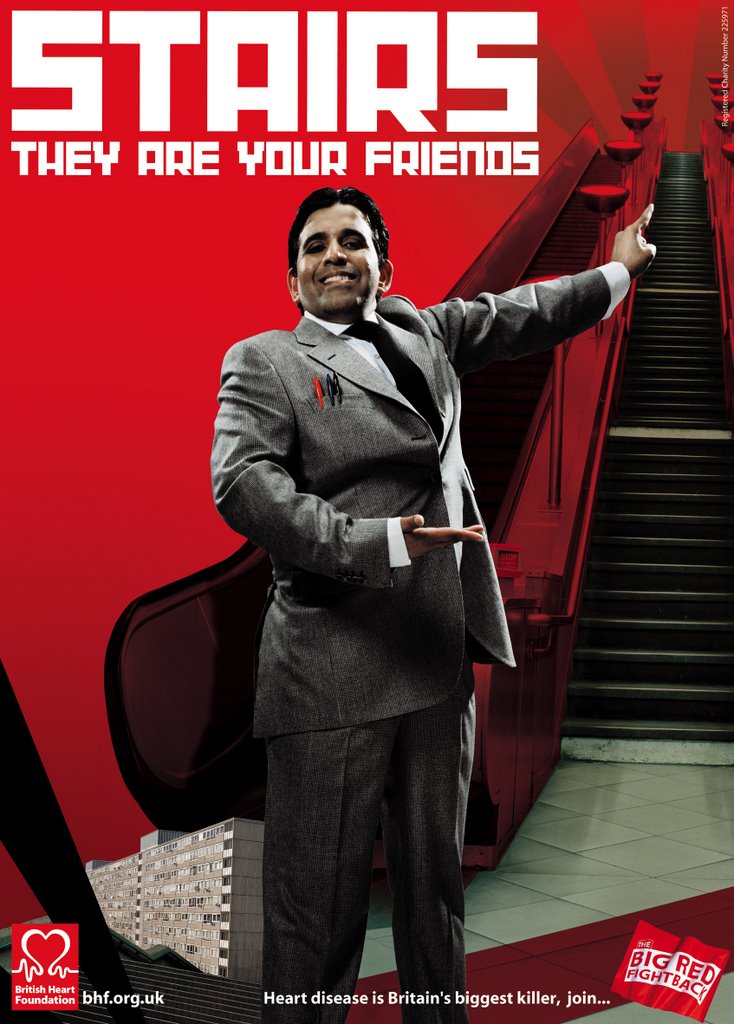
Stairs, they are your friends.


I've been pondering the interplay between the medium and the message for a while now.

It is clear that using media or connection opportunities can help shape the message and bring it to life. Showing that you've thought about the interaction between the message and where you see it, broadens the creative idea. It takes it into another dimension.

Think of the British Heart Foundation, exhorting you to take the steps (rather than riding the escalator) in tube stations, for the sake of your heart.

Or think about VSO (Voluntary Service Overseas) who placed ads about life changing meaningful experiences on the London tube, where the depth of commuter despond is thoroughly plumbed.

I suppose the trick to coming up with opportunities like these it to start at the strategic end. What are we trying to communicate? Who are we reaching? Is there any way of bringing the thought to life in a physical way for the consumer?

One idea I'm keen to try out is the 'lost' car key.

Here's the deal; for a car client looking to get more test drives, why not drop a series of real looking car keys and fobs in pubs, or restaurants, the backs of cabs or even the supermarket. In short, wherever your target market goes. You spot car keys on the floor, of course you're going to pick them up. And that's when I've got you - with a carefully crafted and charming message on the back that exhorts you to take a test drive or win a car etc. Its interruptive I know, but I'm sure the copy can offset that. Plus its a new way to reach a market that might not view more traditional media. An even better idea would be to embed an RFID tag in the key fob offering you for example free public transport to the nearest dealership. C'mon... any takers?

I was motivated to write a little about this, having seen Cubemate's post here. Cubemate, aka Dan Ng, is one of the brightest stars in the Planning firmament and I urge you to subscribe to his blog.

Friday, October 06, 2006

Immerse yourself

We wanted to share the excitement and transfer some of the closeness that you get to powerful beasts of the sea at Sea World Florida. Both are concepts only, using outdoor to raise awareness.

Tuesday, October 03, 2006

Why Paris Hilton is Madonna 2.0

Read a great article today that argued that Paris Hilton isn't so much a modern celebrity as a marketing platform like youtube.

The point is that although every song or book she produces totally dies, her omnipresence in popular culture provides her with an inestimable market value. She constantly links to other brands (desingers, restaurants, night clubs, other celebrities) and they constantly link to her.

Guess its true of Posh and Becks too in a way. Though it saddens me to see their level of linkage dropping off, as their popularity wanes.


Monday, October 02, 2006

Tell me that you love me, that its not a one-night stand.

Its less glamorous than selling cars.
And it's hard to do customer service really well.
But After Sales is critical to the customer's experience of the product and therefore the brand.
This campaign encourages drivers of older Volkswagen cars to re-consider getting their servicing and maintenance done at the local Volkswagen dealership.


Friday, August 04, 2006

Wednesday, August 02, 2006

Malcolm Gladwell talks Chairs

Listen here to his lovely talk about the risks in taking what people say at face value. Another nail in the coffin of bad consumer research...
1) Preferences are unstable - think the Coke sip.
2) Beware the perils of introspection: making people explain what they want actually changes their preferences, and often kills innovation.
3) When people explain their actions, they often just make it up, because accessing the unconscious is very difficult.